![A walk through one of my favorite places [EN/ES]](https://img.truvvle.com/?src=aHR0cHM6Ly9pbWcudHJhdmVsZmVlZC5pby9qb3JkeTA4MjclMkYyMDI0LTA2LTA1LTE3LTA2LTY4MS1jb3Zlci1qcGc&width=2000&height=800)
Greetings to everyone in the Wednesday Walk community, where every Wednesday we have the opportunity to publish our walks through our favorite places, show the places we like the most and, in addition, get to know different places in geographies far away from ours.
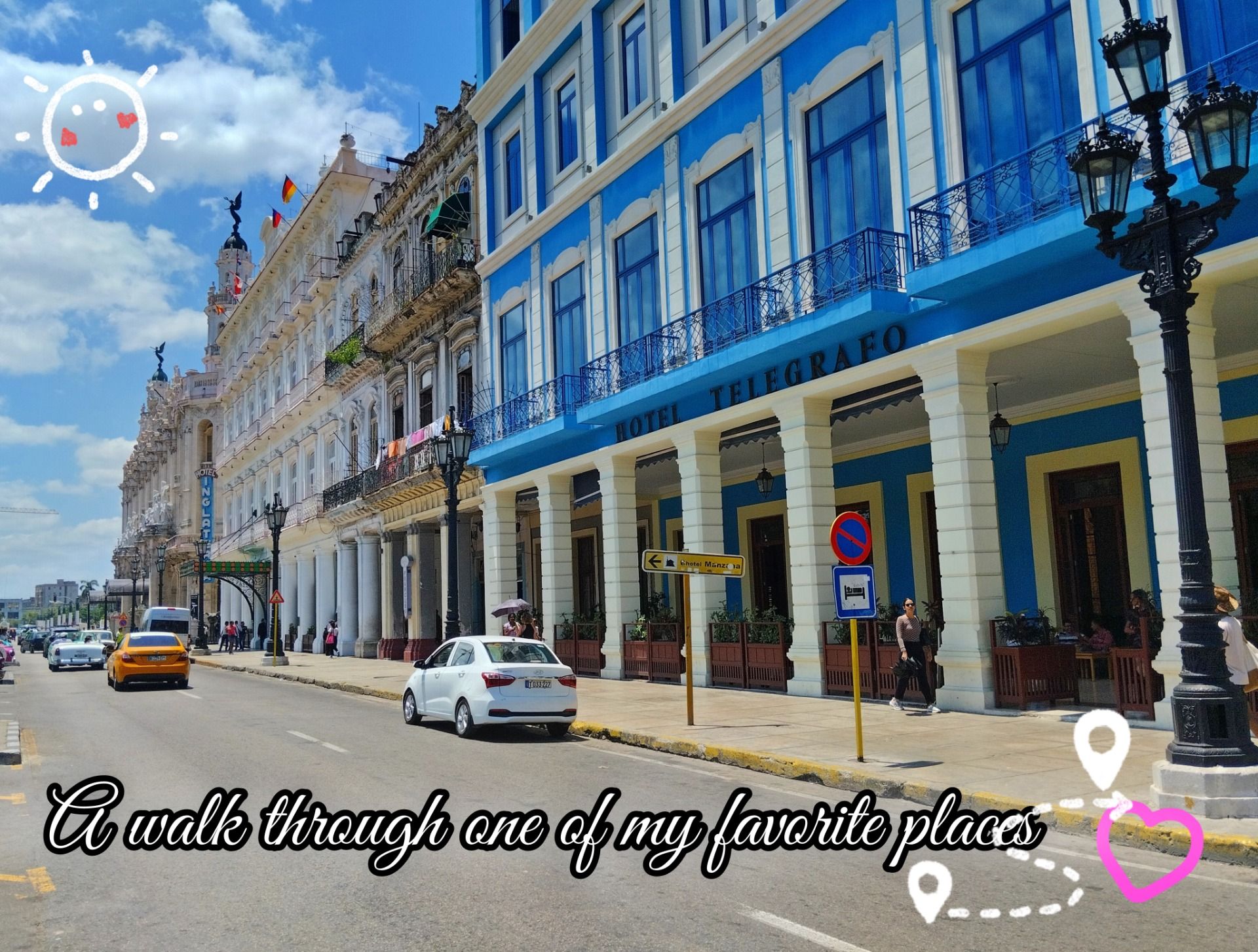
I want to show in my tour some photographs of several buildings in Old Havana, in a walk through some of the streets best known for their history, and for the emblematic buildings that are in them. Although I am from Havana, for me walking the streets of Havana is like being lost in a labyrinth, I recognize the edifications and I locate myself by the most famous buildings, but the names of the streets confuse me, I can't learn them and I never know in which street I am located😂. Even so, I will try to mention them.
I start with Prado street, and this one I do know. I am passing in front of the National Theater of Havana, renamed after Alicia Alonso in memory of that excellent dancer. This beautiful theater, with its admirable architecture and more than 180 years of history, is the headquarters of the National Ballet of Cuba.


Past the Gran Teatro, there are several notable buildings such as the Hotel Inglaterra, with its famous Café Louvre, and further on is the Hotel Telégrafo matching the color of the sky, painted in a blue that does not fail to stand out among the other buildings. This is the oldest hotel in Havana.


The corner of the Hotel Telégrafo is the well-known intersection of Neptuno and Prado streets. Famous corner that was immortalized by the musical theme “La Engañadora”.

Next to these old hotels in the city, there are also more modern and luxurious ones, such as the five-star Hotel Selection Parque Central, named after the park in front of it, where the first statue in honor of José Martí, hero of Cuban independence, is located. So I crossed the street and walked under the leafy trees of Parque Central until I reached the marble statue of the national hero. Since this sculpture was inaugurated, this place has witnessed several important events in the history and culture of Cuba.


From this point, crossing the park to go out to the other end on Agramonte Street, I have in front of me the grandiose view of two amazing buildings. One of them is the Grand Manzana Kempinski Hotel, formerly known as La Manzana de Gómez, which was a large building with several commercial establishments that has now been remodeled into a splendid hotel.


I loved the row of classic cars in the parking lot. There is something to choose from here, for all tastes and colors, but I imagine that renting them must be a bit expensive when there are so many unused 😁.


In front of the park, the other building of great beauty is the one that houses the National Museum of Fine Arts, before this building was dedicated to the Asturian Center, but, after an extensive restoration, it was inaugurated in 2001 as the Museum of Universal Art.


On my list of museums to visit, this one is at the top of the list. I am very much looking forward to seeing its interior and the great collection of works it houses. I hope to be able to do it soon.
Already at this part of my walk I was feeling quite tired, as was my little girl who always accompanies us. So we decided not to continue walking under the sun, which is doubly exhausting, and we went to take a cab, precisely at the famous corner of Prado and Neptuno, since Neptuno is where the 'almendrones' leave to return home (almendrones = cabs, here we call old cars that way, and they are usually used as cabs 🚕).
This is a tour that I like very much, but you have to be well trained physically and have very comfortable shoes to walk through the streets of Havana. I always have things left to see, so I always have a good excuse to return.

VERSION en Español
Un saludo a todos en la comunidad de Paseo de Miércoles, donde cada miércoles tenemos la oportunidad de publicar nuestras caminatas por nuestros lugares preferidos, mostrar los sitios que más nos gustan y, además, conocer diferentes lugares en geografías bien distantes a las nuestras.
Quiero mostrar en mi recorrido algunas fotografías de varias edificaciones en La Habana Vieja, en un paseo por algunas de las calles más conocidas por su historia, y por los edificios emblemáticos que se encuentran en ellas. Aunque soy habanera, para mí recorrer calles de La Habana es como estar perdida en un laberinto, reconozco las edificaciones y me ubico por los edificios más famosos, pero los nombres de las calles se me confunden, no me los logro aprender y nunca sé en qué calle estoy ubicada😂. Aun así, trataré de mencionarlas.
Comienzo por la calle Prado, y esta sí la conozco. Estoy pasando frente al Teatro Nacional de La Habana, rebautizado con el nombre de Alicia Alonso en memoria de esa excelente bailarina. Este hermoso teatro, con su admirable arquitectura y más de 180 años de historia, es la sede del Ballet Nacional de Cuba.
Pasando el Gran Teatro, hay varios edificios notables como el Hotel Inglaterra, con su famoso Café Louvre, y más adelante esta el Hotel Telégrafo haciendo juego con el color del cielo, pintado en un azul que no deja de resaltar entre los demás edificios. Este es el hotel más antiguo de La Habana.
La esquina del Hotel Telégrafo es la conocida intersección de la calle Neptuno con Prado. Famosa esquina que quedó inmortalizada por el tema musical “La Engañadora”.
Junto a estos antiguos hoteles de la ciudad también se encuentran otros más modernos y de lujo como el Hotel cinco estrellas Selection Parque Central, que lleva el nombre del parque que queda al frente, donde se encuentra la primera estatua que se realizó en honor a José Martí, héroe de la independencia de Cuba. Así que crucé la calle y caminé bajo los frondosos árboles del Parque Central hasta llegar a la estatua de mármol del héroe nacional. Desde que se inauguró está escultura, este lugar ha sido testigo de varios hechos importantes en la historia y la cultura de Cuba.
Desde este punto, cruzando el parque para salir al otro extremo en la Calle Agramonte, tengo frente a mí la grandiosa vista de dos asombrosas edificaciones. Uno de ellos es el Hotel Grand Manzana Kempinski, antiguamente conocido como La Manzana de Gómez, el cual fue un amplio edificio con varios establecimientos comerciales que en la actualidad ha sido remodelado para convertirlo en un espléndido hotel. Me encantó la fila de autos clásicos que hay en su parqueo. Aquí hay para escoger, para todos los gustos y colores, pero imagino que su alquiler debe ser un poco caro cuando hay tantos sin utilizar 😁.
Frente al parque, el otro edificio de gran belleza es el que alberga el Museo Nacional de Bellas Artes, antes esta edificación estaba dedicada al Centro Asturiano, pero, después de una amplia restauración, fue inaugurado en el año 2001 como Museo de Arte Universal.
En mi lista de museos pendientes a visitar, este está en el primer lugar. Tengo muchos deseos de conocer su interior y la grandiosa colección de obras que alberga. Espero poder hacerlo pronto.
Ya en esta parte de mi caminata me sentía bastante cansada, al igual que mi niña que siempre nos acompaña. Así que decidimos no seguir caminando bajo el sol, que es doblemente agotador, y nos fuimos a tomar un taxi, precisamente en la famosa esquina de Prado y Neptuno, ya que por Neptuno es que salen los 'almendrones' para regresar a casa (almendrones = taxis, aquí a los autos antiguos les decimos así, y por lo general son usados como taxis).
Este es un recorrido que me gusta mucho, pero hay que estar bien entrenado físicamente y tener unos zapatos muy cómodos para caminar por las calles de La Habana. Siempre se me quedan cosas por ver, así que siempre tengo un buen pretexto para regresar.



![Hotel Inglaterra, elegance and beauty [EN/ES]](https://img.truvvle.com/?src=aHR0cHM6Ly9pbWcudHJhdmVsZmVlZC5pby9qb3JkeTA4MjclMkYyMDI0LTA3LTE2LTIxLTA3LTk4MC1jb3Zlci1qcGc&width=612&height=420)
![Havana Chinatown Gate [EN/ES]](https://img.truvvle.com/?src=aHR0cHM6Ly9pbWcudHJhdmVsZmVlZC5pby9qb3JkeTA4MjclMkYyMDI1LTAzLTMxLTE4LTAzLTUyNi1jb3Zlci1qcGc&width=612&height=420)
